Chiang Rai Temples With Kids: Which Ones Are Worth Visiting? (+ One day Itinerary)
Wondering which Chiang Rai temples are worth visiting with kids? Discover our family-friendly one day itinerary including the White Temple, Blue Temple, Giant Buddha, Red Temple and Lalitta Café, plus practical tips, costs and timings.
THAILANDWHAT TO DOASIA
8/15/202617 min read

If you're planning a family trip to northern Thailand, you may be wondering whether the Chiang Rai temples are worth the extra drive from Chiang Mai.
When we were planning our itinerary, we had the same question. Could a day centred around temples really keep an 8-year-old interested? Were the White Temple, Blue Temple and Red Temple genuinely different enough to visit them all? And would Chiang Rai feel worth the three-hour drive from Chiang Mai?
Quick Answer: Which Chiang Rai Temples Are Worth Visiting With Kids?
All of them!
The temples are visually impressive and very different from anything you'll see elsewhere in Thailand, but they're not attractions designed for children.
They are very close together and easy to see in one day, the key is keeping the visits short, visiting early before the crowds and heat build up, and combining the temples with family-friendly stops such as Lalitta Café.
You can then follow by downtime by the pool back at your hotel. That's exactly what we did, and it turned out to be one of our favourite mornings in northern Thailand.
If you are wondering where to stay while in Chiang Rai, our absolute highlight was staying at The Riverie in Chiang Rai, the mix of watersides, roof top bar and steak house and kids club makes it part of the overall experience staying in Chiang Rai with kids.
If you want to visit in one day and you don't have a car the best option is to check out the Chiang Rai temple tours available here. Both options work, for us visiting overnight and driving ourselves offered more flexibility.
This guide is for families looking for a simple Chiang Rai itinerary that works with kids. I'll cover which temples are worth prioritising, the other stops worth considering, how long you need, what our 8-year-old son Joshua really thought of them.
Just a quick note: some links throughout this guide are affiliate links. This doesn't affect the price you pay, and we only recommend hotels, tours and travel products we've used ourselves or would happily book again.

Should Families Visit Chiang Rai Temples?
As a family, we all really enjoyed Chiang Rai. It was absolutely worth the drive from Chiang Mai, but it worked because we treated it as a focused half-day experience rather than trying to fill an entire day with temples.
The temples themselves are beautiful, but they're not particularly interactive. There are no activities for children, very little shade in places and, realistically, most kids won't want to spend hours walking around religious sites.
What made the day work was the balance.
We visited early, kept moving between locations, stopped for a drink and a wander around Lalitta Café, and then headed back to The Riverie Chiang Rai for the afternoon. Having that mix of sightseeing and downtime made a huge difference.
If you're still deciding whether Chiang Rai deserves a place in your itinerary, our guide to Is Chiang Rai Worth Visiting With Kids? explains how it compares to other destinations in northern Thailand.
Chiang Rai Itinerary
We based ourselves at The Riverie Chiang Rai, which made exploring the city extremely easy.
Our route looked like this:
White Temple
Blue Temple
Lalitta Café
Giant Buddha
Red Temple
Return to The Riverie
The entire route took around half a day and was around one hour of 15 minutes total driving time, and because most attractions are only 10–20 minutes apart, that was broken up into short stints.
We were back at the hotel by lunchtime and able to spend the afternoon enjoying the pool, lazy river and waterslides. That balance is exactly what made Chiang Rai work so well with kids.
Chiang Rai One Day: Costs, Timings & How Long to Allow
One of the reasons Chiang Rai's temples work so well as a family day out is that they're relatively inexpensive and don't require a huge amount of time.
If you're staying in Chiang Rai, I'd recommend leaving your hotel around 8:00am and heading straight to the White Temple, which opens at 8:00am and is by far the busiest attraction. Arriving early helps you avoid both the tour groups and the midday heat.
For timing, this is roughly how our morning looked:
White Temple: 30–45 minutes
Blue Temple: 15–20 minutes
Lalitta Café: 30–45 minutes
Giant Buddha 15–20 minutes
Red Temple: 15–20 minutes
In total, we spent around 3–4 hours including driving between attractions, and were back at The Riverie Chiang Rai by lunchtime.
In terms of cost, the temples are surprisingly affordable:
White Temple: around 100 THB per adult (children discounted)
Blue Temple: Free
Red Temple (Wat Huay Pla Kang): Free
Giant Buddha: Free to visit the grounds, with a small fee (around 40 THB) if you want to take the elevator inside the statue to the viewing platform.
Even including entry fees, Chiang Rai's temples were one of the cheapest days of our Thailand trip. We spent around £4–£5 as a family to visit the White Temple, Blue Temple, Red Temple and Giant Buddha, rising to around £6–£7 if you choose to take the elevator inside the Giant Buddha statue.


Is White Temple Worth Visiting?
If you're only visiting one temple in Chiang Rai, we'd make it the White Temple (Wat Rong Khun).
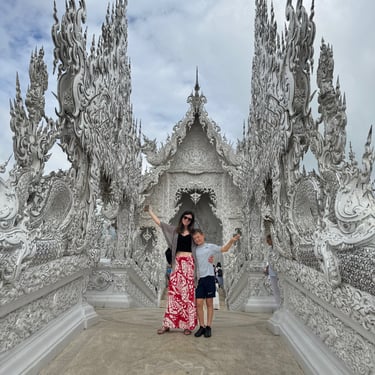
Designed by Thai artist Chalermchai Kositpipat, the White Temple is less like a traditional historic temple and more like a huge contemporary artwork. Its brilliant white exterior, mirrored details and unusual sculptures make it completely different from any other temple we visited in Thailand.
What surprised us was how much Joshua enjoyed the visit. The famous bridge surrounded by outstretched hands immediately grabbed his attention and sparked far more conversation than we'd expected. The symbolism represents ideas including human desire and suffering, but from a child's perspective, it was simply fascinating and slightly creepy.
We visited early, which I'd recommend for families. The temple becomes much busier once tour groups arrive later in the morning. It was our first planned stop on our one day Chiang Rai itinerary.
Would I travel all the way from Chiang Mai just for the White Temple? Probably not. For us, what made Chiang Rai worthwhile was combining it with the Blue Temple, Giant Buddha, Red Temple and Lalitta Café, then returning to our hotel for a relaxed afternoon.
White Temple Chiang Rai Entrance Fee
The White Temple Chiang Rai entrance fee is currently 200 THB (around £4.50) for foreign visitors. The price increased from 100 THB on 1 January 2026, so you may still find older prices quoted online.
Admission was free for children under 120cm and visitors aged 70 or over. Unfortunately Joshua didn't fit this bracket, he paid a reduced fee.
For us, it was well worth paying to visit, particularly because the unusual artwork made it more engaging for Joshua than we'd expected.
White Temple Chiang Rai Opening Hours
Current White Temple Chiang Rai opening hours are generally 8am to 5:30pm daily, although hours can change around public holidays and special events.
I'd recommend arriving as close to opening time as possible. You'll benefit from cooler temperatures and fewer tour groups, which makes exploring with children much easier.
We spent around 30–45 minutes here, which felt about right. Long enough to appreciate the details and take photos, but not so long that Joshua started getting bored.
White Temple Chiang Rai Dress Code
The White Temple Chiang Rai dress code is similar to other Buddhist temples in Thailand. Adults should cover their shoulders and knees, remove shoes before entering temple buildings, and dress respectfully. Kids are generally fine in shorts and T shirt.
We found the easiest approach was simply to dress appropriately for the whole temple-hopping morning. That way, we could move between the White Temple, Blue Temple and other Chiang Rai attractions with ease. A simple scarf for women works well to cover shoulders.
If you're only visiting one Chiang Rai temple, make it the White Temple (Wat Rong Khun).


Is the Blue Temple Worth Visiting?
Yes, absolutely, although for very different reasons to the White Temple.
The Blue Temple (Wat Rong Suea Ten) is known for its vivid sapphire-blue architecture, intricate gold detailing and large white Buddha inside the main prayer hall. It's also much more compact than the White Temple, which makes it particularly easy to include in a family sightseeing day.
What I liked most was how easy it was to visit with Joshua. Th blue temple is compact enough that you can see everything in around 15–20 minutes. As parents, that's actually a huge advantage.
The colours immediately caught Joshua's attention, and the huge white Buddha inside gave it a completely different atmosphere to the White Temple. Rather than choosing between them, I'd recommend seeing both because they complement each other really well.
Would I travel from Chiang Mai purely for the Blue Temple? Probably not. But as part of a wider Chiang Rai itinerary, it's an easy stop that adds something completely different.
Blue Temple Chiang Rai Entrance Fee
One of the bonuses for families is that the Blue Temple Chiang Rai entrance fee is currently free. Donations towards the upkeep of the temple are welcomed but aren't compulsory.
That makes it an easy attraction to add to your day without worrying about whether you'll get enough value from the visit, particularly if children only want to spend a short time exploring.
Blue Temple Chiang Rai Opening Hours
The current Blue Temple Chiang Rai opening hours are 7am to 8pm daily.
For families, I'd recommend visiting early if you can. It makes sense to combine the Blue Temple with other Chiang Rai attractions such as the White Temple and Wat Huay Pla Kang rather than treating it as a standalone excursion.
Blue Temple Chiang Rai Dress Code
As the Blue Temple is an active Buddhist temple, visitors should dress respectfully. The Blue Temple Chiang Rai dress code means keeping shoulders and knees covered if stepping inside the temple itself. Shoes should be removed before entering the main prayer hall.


Is the Red Temple Worth Visiting?
The Red Temple was actually one of the quietest stops of our morning. It tends to be overshadowed by Chiang Rai's more famous White and Blue Temples, but that was part of its appeal for us.
The wider Wat Huay Pla Kang complex combines Chinese and Lanna architectural influences, with red, gold and green detailing that gives it a completely different feel from the other temples we'd already visited.
By this point, we'd already visited the White and Blue Temples, so I wasn't sure whether another temple would add much. In reality, it rounded off the morning nicely. It felt calmer, involved very little walking and gave Joshua something different to explore without committing to another long sightseeing stop.
We spent around 10-15 minutes around the Red Temple itself, which felt about right. I wouldn't make a special journey purely to see it, but if you're visiting Wat Huay Pla Kang, I'd definitely include it.
Red Temple Chiang Rai Entrance Fee
Entry to the Wat Huay Pla Kang complex is free, so you can explore the temple grounds without buying a ticket.
For families, that makes the Red Temple an easy addition to a Chiang Rai temple itinerary because you don't need to worry about paying another entrance fee for what might only be a short stop.
Red Temple Chiang Rai Opening Hours
Wat Huay Pla Kang is open daily from 7am until 9pm.
We visited as part of our morning temple route, which worked really well with Joshua. By combining it with the Giant Guan Yin rather than treating it as a separate attraction, it added very little extra travelling or sightseeing time.


Is the Giant Buddha Worth Adding?
Absolutely. Although most people refer to it as the Giant Buddha, the huge white statue at Wat Huay Pla Kang is actually Guan Yin, the Goddess of Mercy, making it quite different from many of Thailand's traditional temple attractions. The statue dominates the Chiang Rai skyline and is visible from surprisingly far away (we could actually see it from our hotel roof top bar!), which immediately gives it that "wow" factor as you approach.
One of the things that makes it stand out is that you can actually go inside. Visitors can either climb the stairs or pay a small fee to take the elevator up through the statue to a viewing area near the top, where you can look out across Chiang Rai and the surrounding countryside.
We didn't make it to the top ourselves. By this point in the morning, we'd already visited several temples and everyone was starting to flag a little. Instead, we admired it from ground level, wandered around the complex and took in the scale of the statue from below. It was a quick 15 minute photo stop for us.
For families, I actually think that's enough. The sheer size of the statue, the dragon staircases leading up to it and the views across the complex make it feel very different from the White Temple and Blue Temple. Joshua enjoyed it because it felt more like a landmark than another temple, and that variety helped keep the morning interesting.
If you're already visiting the nearby Red Temple, I'd definitely include it. It's one of the most iconic sights in Chiang Rai and adds very little extra time to the route.


Chiang Rai Coffee Stop - Lalitta Café a Unique Chiang Rai Experience
One of the smartest decisions we made was breaking up the temples with a stop at Lalitta Café.
By the time we'd visited the White Temple and Blue Temple, I could already see Joshua starting to lose interest. Not because the temples weren't impressive, but because there are only so many statues, buildings and photo stops an 8-year-old wants to see in a row. As parents, it's easy to fall into the trap of thinking "it's only another temple 10 minutes away" without realising how repetitive that can feel from a child's perspective.
Lalitta Café changed the pace completely. Instead of being told to walk around another temple, Joshua was crossing bridges, exploring waterfalls and, most importantly, feeding the fish. In fact, if you asked him to rank the morning's highlights, there's a good chance the fish feeding would come above at least one of the temples.
Looking back, I think that's why the day worked so well. The temples gave us the iconic Chiang Rai sights we wanted to see, while Lalitta Café gave Joshua a chance to move around, burn off some energy and reset before the final stops. It turned the morning from a temple-hopping exercise into something that felt much more balanced for the whole family.
If you're planning a similar route, I'd strongly recommend including a break between temple visits. For us, Lalitta Café was the perfect place to do that. You can read more about what it's actually like in Lalitta Café Chiang Rai With Kids


Where to Stay With Kids When Visiting Chiang Rai's Temples
If you're planning to visit the White Temple, Blue Temple and Wat Huay Pla Kang, I'd strongly recommend spending at least one night in Chiang Rai rather than trying to cram everything into a day trip from Chiang Mai.
That's what we did, and it transformed the experience. Instead of rushing between attractions and facing a six-hour round trip drive, we could visit the temples at a relaxed pace, stop at Lalitta Café and still be back at the hotel by lunchtime.
We stayed at The Riverie Chiang Rai, which turned out to be one of our favourite family hotels in Thailand. Its location made it an excellent base for exploring the temples, while the pools, waterslides and lazy river gave Joshua something to look forward to after a morning of sightseeing.
In fact, I think this is the key to making Chiang Rai work with kids. The temples themselves are impressive, but they don't fill an entire day. Pairing a few hours of sightseeing with an afternoon at a genuinely family-friendly hotel creates a much better balance.
If you're considering staying overnight, see The Riverie Chiang Rai Review where I share our full experience, room review and why I think it works so well for families.
If you're still deciding whether to stay overnight or visit as a day trip from Chiang Mai, our guide to Chiang Mai vs Chiang Rai With Kids: Which Should Families Choose? explains the pros and cons of both options.
Can You Visit Chiang Rai's Temples Without a Car?
Yes, absolutely.
While we chose to hire a car, you don't need one to visit Chiang Rai's main temples. The easiest alternatives are either booking a guided tour or hiring a private driver for the morning.
In fact, many of the most popular Chiang Rai tours already combine the White Temple, Blue Temple, Wat Huay Pla Kang (Giant Buddha), Red Temple and Lalitta Café into a single itinerary. For families, this can be a very practical option because it removes the stress of navigation, parking and route planning while still covering the main sights.
That said, there is a trade-off. One of the things we liked about having our own car was being able to leave whenever Joshua was ready to move on. The temples are relatively quick visits, and children often have very different attention spans to adults. Having complete control over the timing made the day feel much more relaxed.
Chiang Rai Tour Package
If you don't want to drive, I'd recommend taking a look at some of the Chiang Rai temple tours available and comparing the itineraries. Most cover all of the key attractions, and some include additional stops we didn't visit. Even if you decide not to book, they're a useful way to see how a typical Chiang Rai sightseeing day is structured.
If you're considering hiring a car yourself, our guide to Driving in Chiang Mai: Is It Safe, Easy and Worth It for Families? explains how we approached driving in northern Thailand and why it worked well for our family.


Chiang Rai Attractions We Didn't Include : The Golden Triangle
One attraction we deliberately left out was the Golden Triangle, the famous point where Thailand, Laos and Myanmar meet along the Mekong River.
It's one of Chiang Rai's best-known attractions and is often included in organised Chiang Rai day tours. However, from the temple area, it would have added roughly an extra hour of driving each way, turning what we found to be a relaxed half-day itinerary into something much longer.
For us, it came down to priorities. We'd rather spend more time enjoying the main temples, then return to the hotel for some pool time, rather than add more time in the car.
If you're particularly interested in the history of the region or are spending several days in Chiang Rai, the Golden Triangle may well be worth adding. But for families trying to keep the day manageable with children, I don't think it's essential. We never felt like we'd missed out, and by keeping our route focused, Joshua was still engaged and enjoying himself by the end of the morning rather than asking when we were going back to the hotel.
Practical Tips for Visiting Chiang Rai Temples With Kids
A few simple things made the day much easier:
Visit the White Temple first before the crowds arrive.
Don't expect to spend hours at each temple.
Bring water, hats and sunscreen.
Dress respectfully with shoulders and knees covered.
Let children take photos and engage in their own way.
Break the morning up with a café stop or non-temple attraction
Book a family hotel with a pool as your base


So, Which Chiang Rai Temples Are Actually Worth Visiting?
For families, I'd prioritise the White Temple, Blue Temple and Giant Buddha, then add the Red Temple and Lalitta Café if you have the time.
The temples are visually impressive and absolutely worth seeing, but they're unlikely to hold most children's attention for an entire day. We found Chiang Rai worked best as a focused half-day itinerary, combining a handful of memorable attractions with a café stop and some downtime afterwards.
That's exactly how we approached it. By keeping expectations realistic, moving at Joshua's pace and returning to The Riverie Chiang Rai for the afternoon, what could have been an exhausting sightseeing day became one of the most enjoyable parts of our northern Thailand trip.
If you're already visiting Chiang Mai and can spare one night or a day trip, I'd say Chiang Rai's temples are well worth including in your itinerary. Just don't try to turn them into a full-day attraction on their own.
FAQs About Visiting Chiang Rai Temples With Kids
Are Chiang Rai temples worth visiting with children?
Yes, especially if your children are school-age. The White Temple, Blue Temple and Giant Buddha are visually unique and very different from anything you'll see elsewhere in Thailand. The key is keeping the visits relatively short and combining them with other attractions such as Lalitta Café or some pool time afterwards.
How many Chiang Rai temples should you visit in one day?
Most families can comfortably see all of Chiang Rai's main temples in half a day. We visited the White Temple, Blue Temple, Giant Buddha and Red Temple, with a stop at Lalitta Café in between, and never felt rushed. The temples themselves don't take long to explore, so the key is balancing sightseeing with breaks rather than trying to spend hours at each location. For families, I'd focus on quality over quantity and aim to be back at your hotel by lunchtime to enjoy the rest of the day.
If you're planning your route, see Chiang Mai & Chiang Rai With Kids: A 3-Day Family-Friendly Itinerary, where I share exactly how we structured our time in northern Thailand.
Which Chiang Rai temple is the best for families?
The White Temple (Wat Rong Khun) is the one I would prioritise if you're short on time. It's the most striking, has the most unusual details and was the temple that captured Joshua's attention the most.
Can you visit Chiang Rai temples as a day trip from Chiang Mai?
Yes. Many families visit on a guided tour or with a private driver from Chiang Mai. However, if you have the flexibility, I'd recommend staying overnight in Chiang Rai. It allows you to explore at a much more relaxed pace and enjoy attractions like Lalitta Café and The Riverie Chiang Rai without feeling rushed.
If you're considering staying over, read The Riverie Chiang Rai Review to see why it worked so well for our family.
How long do you need to visit Chiang Rai's temples?
Most families only need half a day. The White Temple takes around 30–45 minutes, the Blue Temple around 15–20 minutes, and the Red Temple and Giant Buddha can be visited quite quickly. We comfortably completed the entire route in one morning and were back at the hotel by lunchtime.
If you're wondering what else to do in the area, see Is Chiang Rai Worth Visiting With Kids? The Attractions We'd Prioritise, where I cover the other family-friendly sights beyond the temples.
Is the Giant Buddha worth visiting in Chiang Rai?
Yes. Although it's not one of the famous coloured temples, it's one of the most impressive sights in Chiang Rai and is conveniently located next to the Red Temple. It adds something different to the itinerary and gives families a break from temple hopping.
What's the best route for visiting Chiang Rai temples?
We found the most efficient route was: White Temple → Blue Temple → Lalitta Café → Giant Buddha → Red Temple → The Riverie Chiang Rai
This gets you to the White Temple first, when it's at its quietest, minimises driving and breaks up the sightseeing with a more family-friendly stop at Lalitta Café. It kept the morning varied and manageable, while still allowing us to see all of Chiang Rai's highlights before heading back to the hotel.
plan your TRIP TO chiang rai
If you’re planning your family trip to Chiang Rai, these guides will help you pull everything together:


About Plan Family Escapes
We’re a UK-based family sharing real, experience-led travel guides based on trips we’ve taken with our school-age son Joshua across destinations like Lapland, Turkey and India.
Everything we share is based on what we’ve personally experienced — with honest advice on what actually works when travelling with kids, focusing on making family travel easier, more comfortable and genuinely enjoyable.