
Getting Around Thailand With Kids: Flights, Trains, Taxis, Grab & Driving Explained
A practical guide to getting around Thailand with kids, covering internal flights, trains, taxis, Grab, drivers and when driving yourself makes sense. Includes practical family tips, honest context and planning advice to help parents decide before booking.
THAILANDRESOURCESASIA
9/2/202612 min read

If you're wondering how to get around Thailand with kids, this guide is for you.
When we started planning our trip, transport was one of the things I worried about most. Looking at the map, the distances between Bangkok, Chiang Mai, Chiang Rai and Phuket seemed huge. Should we fly or take the train? Is it worth hiring a car? Can you rely on taxis? Is Grab really as good as everyone says?
Quick answer: how should you get around Thailand with kids?
For most families, the easiest and most efficient approach is to combine internal flights for long distances, Grab for cities, a hire car in northern Thailand, river boats in Bangkok and the occasional tuk tuk for fun.
That's exactly what we did during our family trip with Joshua (aged 8), travelling between Bangkok, Chiang Mai, Chiang Rai and Phuket. Transport ended up being far easier than we expected, and choosing the right option in each location saved us a huge amount of time and energy. For most 2-week Thailand itineraries, I'd prioritise domestic flights over long train or bus journeys and use Grab whenever you're staying in major tourist areas.
This guide is for families planning a multi-stop Thailand itinerary and trying to work out the most practical way to travel between destinations. We'll cover internal flights vs trains, buses and ferries, car hire, Grab, tuk tuks, river boats and travel day planning, along with what worked best for us and what we'd do again.
If you're still planning your route, read this alongside:
Just a quick note: some links in this guide are affiliate links. This doesn't affect the price you pay, and we only recommend travel services and products we'd happily use again ourselves.


Internal Flights vs Trains vs Taxis: What's Best for Families?
One of the biggest surprises when planning a Thailand family holiday is just how far apart some destinations are. Bangkok, Chiang Mai, Chiang Rai and Phuket can look relatively close on a map, but overland journeys can quickly consume an entire day. For that reason, we chose internal flights between major destinations and would absolutely do the same again.
Why We Chose Internal Flights
The biggest advantage wasn't simply the time saved. It was the energy saved.
Anyone travelling with children knows that travel days are exhausting. Packing, checking out, airport transfers, flights, baggage collection and finding your next hotel already take enough effort. Replacing a short flight with a full-day rail journey simply didn't make sense for our itinerary.
Our domestic flights were:
Bangkok to Chiang Mai – approximately £200 for a family of three
Chiang Mai to Phuket – approximately £112 for a family of three
Phuket to Bangkok – approximately £90 for a family of three
We used both Thai Airways and Air Asia. Thai Airways felt similar to flying with British Airways, while Air Asia was more like easyJet. Both worked perfectly well for short domestic journeys, although Thai Airways was slightly more comfortable.
For price comparisons I suggest start with Trip.com and go from there.
What About Trains?
Thailand's overnight trains are popular, particularly the Bangkok to Chiang Mai sleeper train, and for some families the journey itself becomes part of the adventure.
However, for a 2-week Thailand itinerary with kids, we felt flying was the more practical option. The Bangkok to Chiang Mai train takes around 11–14 hours, while a flight takes just over 1 hour. Similarly, travelling from Bangkok to Phuket by bus can take 12–14 hours, compared to around 90 minutes by plane.
Thailand's long-distance bus network is extensive and significantly cheaper than flying, but the trade-off is time. If you're travelling for three or four weeks, buses and trains can make more sense. If you're trying to fit Bangkok, Chiang Mai, Chiang Rai and Phuket into a two-week family holiday, those travel hours quickly eat into sightseeing time.
What About Buses, Ferries and Boats to the Islands?
Many travellers combine buses, trains and ferries to reach Thailand's islands, often saving money in the process. For example, you can travel from Bangkok to southern Thailand by overnight train and then connect to an island ferry, or take ferries between islands once you're there.
The downside is that journeys can become quite long once transfers and waiting times are added together. With children, we generally found that spending a little more on flights gave us more holiday time and less travel fatigue.
I've actually done this myself on a previous trip to Thailand before travelling with Joshua. As a solo traveller, I enjoyed the experience and didn't really mind the long travel days. However, it's not something I would have wanted to repeat with a child. What looks straightforward on paper often involves multiple changes, waiting for connections, carrying luggage between stations and ports, and spending a significant part of the day in transit.
For our itinerary, though, internal flights offered the best balance of cost, convenience and energy levels. When travelling with kids, arriving in an hour rather than spending half a day on a bus or train often felt worth the extra cost.




Car Hire in Chiang Mai and Chiang Rai
Hiring a car was one of the decisions I was most unsure about before travelling. In reality, it became one of the best parts of our trip.
We paid approximately £191 for a hire car with comprehensive insurance, which was intentionally cautious because we weren't sure what driving conditions would be like. Having read various forums beforehand, I was expecting challenging roads, chaotic traffic and a fairly stressful experience.
The reality was very different, the roads were generally in good condition, major routes were easy to follow using Google Maps, and traffic was far more manageable than we expected. Once we left Chiang Mai city, driving felt surprisingly straightforward and gave us a level of flexibility that would have been difficult to replicate using tours or taxis.
More importantly, having a car gave us freedom. Rather than organising transport every time we wanted to visit somewhere, we could simply jump in the car, stop whenever something looked interesting, and change plans if the weather changed. This was particularly useful during a few rainy days when we decided to swap activities around at short notice.
We initially hired a small car to keep costs down and it was perfectly adequate. That said, after driving through some heavy rain and spending long periods on the road, I think we'd probably choose something slightly larger next time for extra comfort and luggage space. Even so, we had no issues, no accidents and never felt unsafe.
The biggest advantage came once we reached Chiang Rai. Many of the area's best attractions are spread out across the province, and having our own transport made it easy to explore at our own pace rather than trying to coordinate multiple taxis or join organised tours.
For families following a similar route, I'd strongly consider hiring a car for the northern Thailand section of the trip. The flexibility, convenience and relatively low cost made it one of the best value decisions we made during the holiday. It allowed us to explore beyond the main tourist sites, stop whenever we wanted, and adjust plans around the weather without being tied to tour schedules or taxi availability.
If you're planning to combine both destinations, see Chiang Mai & Chiang Rai With Kids: A 3-Day Northern Thailand Itinerary, where I share the exact route we drove, how long the journeys took, the attractions we visited along the way and why having a hire car made the itinerary much easier to manage as a family.
If you're wondering about driving rules, road conditions, insurance and whether it's realistic with children, read Driving in Chiang Mai: Is It Safe, Easy and Worth It for Families?, where I cover the experience in much more detail and share what I wish I'd known before collecting the keys.
If you're planning to drive in Chiang Mai or Chiang Rai, take a look at the latest Trip.com car hire options. We found having our own car gave us far more flexibility than relying on tours or taxis and made exploring northern Thailand much easier with a child.


Using Grab in Thailand: The App Every Family Should Download
If there's one app I'd recommend installing before you board your flight to Thailand, it's Grab.
Think of it as Thailand's version of Uber, although in many ways we found it even more useful. Before travelling, I'd read countless recommendations for Grab and assumed it was simply a convenient taxi app. After two weeks in Thailand, I'd say it became one of the most important tools we used throughout the entire trip.
We used Grab for:
Airport transfers
Getting around Bangkok
Getting around Phuket
Restaurant visits
Shopping trips
Travelling between attractions
A journey between Bangkok and Ayutthaya
In fact, we ended up using Grab far more than traditional taxis. One of the biggest advantages is that it removes much of the uncertainty that can come with travelling in a new country. Rather than trying to explain destinations, negotiate prices or worry about whether a taxi meter is running properly, everything is handled through the app.
The Ayutthaya journey is a perfect example. Originally, I assumed we'd take the train, as that's what many guidebooks recommend. However, once we factored in getting to the station, buying tickets, the train journey itself, then arranging transport from Ayutthaya station to the various temple sites, Grab simply felt easier.
The journey was surprisingly affordable, door-to-door and considerably less stressful than trying to coordinate multiple forms of transport in the heat with a child. If you're considering visiting Ayutthaya independently, see Ayutthaya by Train From Bangkok: DIY Family Day Trip, where I compare the different transport options and explain why many families may prefer a simpler door-to-door approach.
Download Grab Before You Leave Home
One tip I wish I'd known earlier is to set everything up before you travel.
Download the app, create your account and add your payment method before flying. The last thing you want after a long international flight is to be standing in Bangkok Airport trying to download apps using airport Wi-Fi.
This is also where having an Airalo eSIM or local data plan becomes incredibly useful. We relied heavily on mobile data for Grab, Google Maps and attraction information throughout the trip.
Are Taxis Still Worth Using?
Traditional taxis are still widely available, particularly in Bangkok.
However, after trying both, we found ourselves choosing Grab almost every time. Knowing the cost upfront and being able to track the journey removed a lot of uncertainty and made travelling around the cities much more relaxed.
The only exception was the occasional tuk tuk ride, which we treated as part of the experience rather than a practical transport solution.


Tuk Tuks: Not the Most Practical, But Definitely the Most Fun
Tuk tuks aren't always the easiest way to get around. They're often slower than Grab, less comfortable in hot weather and not always the cheapest option.
But children tend to love them. Joshua certainly did.
We used tuk tuks several times in both Bangkok and Ayutthaya, and while they weren't usually the most efficient way to travel, they were definitely among the most memorable. For Joshua, hopping into a brightly coloured tuk tuk and weaving through the streets felt like an attraction in its own right rather than simply a way to get from A to B.
For us, tuk tuks were more about the experience than the transport. We used them occasionally for short journeys, sightseeing and exploring local areas, but relied on Grab for most practical travel. If you're travelling with children, I'd recommend trying at least one tuk tuk ride during your trip, even if it's just for the novelty.
In Bangkok particularly, they can be a fun way to explore some of the city's most famous sights. If you're deciding which attractions are actually worth your time, see 12 Bangkok Attractions Worth Visiting With Kids, where we cover the temples, markets, river experiences and family-friendly attractions we genuinely enjoyed.
Think of tuk tuks as something fun to try rather than your primary transport strategy. They're part of the Thailand experience, but probably not the transport option you'll use every day.

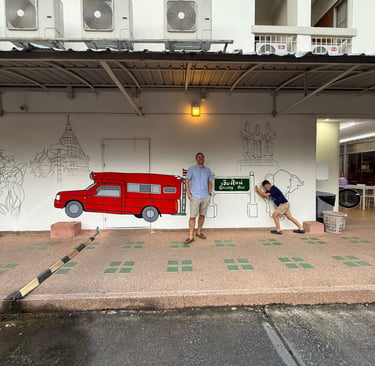


Why River Boats Are One of the Best Ways to Explore Bangkok
One of our favourite forms of transport in Thailand wasn't on the road at all. It was on the Chao Phraya River.
The river boats ended up being one of the easiest ways to explore Bangkok with a child because they are:
Affordable
Easy to use
Airy compared to traffic-filled roads
Great fun for children
Convenient for major attractions
What started as transport quickly became part of the sightseeing experience. Many of Bangkok's biggest attractions sit close to the river, making boats one of the most efficient ways to move around the city.
For a full guide, see Bangkok Hop-On Hop-Off River Boat: Easy Temple & Chinatown Tour With Kids.


Final Verdict: What's the Best Way to Get Around Thailand With Kids?
Before travelling to Thailand, transport was one of the things I worried about most. Looking at the distances between Bangkok, Chiang Mai, Chiang Rai and Phuket, it felt like getting around could easily become stressful and time-consuming.
In reality, it was much easier than expected. For families, I think the best approach is to combine different transport options depending on where you are in the country rather than relying on just one. Internal flights saved huge amounts of time between regions, Grab made city travel effortless, hiring a car gave us freedom in northern Thailand, and river boats turned getting around Bangkok into part of the experience.
Looking back, the transport combination that worked best for us was:
Internal flights between Bangkok, Chiang Mai and Phuket
A hire car for Chiang Mai and Chiang Rai
Grab for day-to-day travel in cities
River boats in Bangkok
Tuk tuks occasionally for the fun factor
Most importantly, don't underestimate travel days. Even short flights can take up much of the day once you add transfers, check-in and hotel changes. Give yourself enough time in each destination and avoid trying to move locations too frequently.
If you're following a similar route to ours, transport in Thailand is unlikely to be the challenge you expect. With a little planning, it becomes part of the adventure rather than something to worry about.
FAQs About Getting Around Thailand With Kids
Is it easy to travel around Thailand with children?
Yes. Thailand is one of the easiest countries in Asia to travel around with children. Domestic flights are affordable, transport infrastructure is well developed, Grab is widely available, and most tourist areas are set up to accommodate families. We found getting around much simpler than we expected before the trip.
Should families fly or take the train in Thailand?
For a 2-week itinerary, I'd generally recommend flying between major destinations. The Bangkok to Chiang Mai train can be a great experience, but a one-hour flight saves a significant amount of time and energy. If you're travelling for several weeks, trains become a more attractive option.
Is Grab better than taxis in Thailand?
For us, absolutely. Grab shows the fare before you travel, removes the need to negotiate prices and allows you to track your journey through the app. We used Grab extensively in Bangkok and Phuket and found it reliable, affordable and very family-friendly.
Is it worth hiring a car in Chiang Mai and Chiang Rai?
If you're planning to explore beyond the city centres, definitely. Hiring a car gave us far more flexibility and made it easier to visit temples, viewpoints, cafés and attractions spread across northern Thailand. We found driving much easier than expected and would happily rent a car again on a future trip.
Having our own transport allowed us to visit places such as the White Temple, Blue Temple, Red Temple, Lalitta Café and the Big Buddha on our own schedule, without needing to organise multiple taxis or join organised tours. It also made it much easier to adapt plans around the weather, which came in useful during a few rainy days.
If you're considering a similar route, read Driving in Chiang Mai: Is It Safe, Easy and Worth It for Families?, where I share the realities of driving in northern Thailand, what insurance we chose, road conditions, costs and whether I'd recommend it for families.
Is Travel in Thailand Expensive for Families?
Not compared to many long-haul family destinations. Flights and hotels are usually the biggest costs, while local transport, food and attractions can be surprisingly affordable. For a full cost breakdown, see How Much Does a Family Trip to Thailand Cost?
plan your TRIP TO thailand
If you’re planning your family trip to Bangkok, Chiang Mai & Phuket, these guides will help you pull everything together:


About Plan Family Escapes
We’re a UK-based family sharing real, experience-led travel guides based on trips we’ve taken with our school-age son Joshua across destinations like Lapland, Turkey and India.
Everything we share is based on what we’ve personally experienced — with honest advice on what actually works when travelling with kids, focusing on making family travel easier, more comfortable and genuinely enjoyable.